News and Happenings at the museum!
One of the main priorities of the New England Accordion Museum is to keep the spirit of the accordion and its influence alive.
With a variety of accordion brands including: Giulietti, Bugari, Dino Baffetti, Hohner, Paolo Soprani, and more, these vintage traditional accordions each provide their own unique story and history. Paul Ramunni makes it a point to share with all visitors the stories of the accordions within his collection. Each accordion has a story to tell and their memories are worth hearing.
Along with the stories are historical facts about the accordion and its history as well as featured articles about those in the accordion industry. Our mission is to preserve the history of accordions and supporting those who are or would like to understand the accordion industry better.
8/16/2026
I’ve been wondering… (part 1)
For some time now, we’ve been gathering at our accordion museum every month to hear people sing and play their musical instruments. We’ve had singers, violinists, flautists, an oboe player, drummers, guitarists, harmonica players, pianists, autoharp players, and of course a goodly number of accordionists. What never ceases to amaze me is that we never have any disagreements or stress among the players and listeners even though most of us do not know each other. We all get along…and I’ve been wondering why and how that can be. After all, the media keeps telling us daily about the conflicts and wars all over our country and in the world. We are so divided that it can keep us from wanting to gather and enjoy the music.
I’ve been looking at the possibility that perhaps music has more power and impact than we think. It may have the ability to neutralize the bad feelings, fears and thoughts we have toward other people. If that is the case, then it is most important for us to understand how it works. After hosting and curating our accordion museum (www.neacmc.com) for the last 18 years, here is what I’ve learned so far:
-Music has the ability to transport us back to a previous time in our lives. Many of the songs we listen to today originated in the past. When we hear them in the present, our thoughts can go back to the memory of better times. We remember the good old days when friends, gatherings, feelings were pleasant and people were perhaps more friendly. Life seemed more predictable. Music then, has the power to take us away from the unpleasant present and replace it with the familiar and nostalgic past.
-Music can place us in a kind of “bubble state” where it can dominate our thoughts and attention and filter out the worries and stresses of the present. In a way, we can be temporarily separated from our worries. It also disarms us from the need to shield and protect ourselves from perceived threats and disagreements we may be living with.
-Assuming that these first two points are true, music then has a clean “page to write on” for the listeners present. We can enjoy the full impact and meaning of the music being played without being influenced by the problems and worries in our lives. Hence, everyone present can become more pleasant! Music can provide us with a release and a way to enjoy each other’s’ company so our differences of opinions are set aside, at least for a while.
-I’ve also wondered about another possible quality or characteristic about music. There is archeological evidence that music, in some form and shape, has been part of human development for many thousands of years. It appears in many of the spiritual and celebrational experiences of families, tribes and countries of the distant past.
But most importantly, it seems to have a special link to the divine. Many church and spiritual services around the world today are filled with musical worship which has been passed down to us from the distant past. I think we all have a secret desire to communicate with our God, and music has always been, and still is, a powerful way to experience a bit of heaven while here on earth. This last point is really intriguing to me especially as I approach the last part of my life. I suspect that there are some eternal truths I have yet to discover, and these are critical to my completing a life well lived. Access to these truths may be through the door of music.
This is why we have we have our accordion museum. I’ve come to believe that many of us tend to preserve the stories and instruments that remind us that music is more than just a collection of sounds. It can become a bridge for us between generations and cultures. It may even serve as a bridge to the eternal.
Please forward your thoughts and comments to me in the days to come. Whatever else I discover about this topic, I will continue to share with you.
Thank you…
Paul Ramunni
Our next “Groovin’ at the Depot” meeting is Sunday, 9/20/26 … 3 PM to 5 PM***
8/23/26
I’m Still Wondering… (Part 2)
My last posting a week ago spoke of how music helps us recall the past and can help transport our memories back to special times. It also helps us come together and make friends regardless of strong beliefs and differences. I also mentioned, that for many people, music can provide us with a connection to the divine. That last point reminded me of an unanswered question I had for the longest time. I always wondered what caused the explosion of all the hymns that were written back in the 1800’s. It’s reported that in the 19th century alone, well over 400,000 hymns were composed, and it is likely that more than 500,000 were written worldwide over that period. It was the time of the Second Great Awakening which occurred from 1790 – 1840.
In the early 1800’s people were faced with many challenging issues including rapid social change from industrialization. American families and businesses were moving westward. Democratization in the new American government was something people were trying to get used to. There were strong desires for moral reform, anxiety over social issues with slavery, poverty, and women’s roles topping the list. We would have to add to that the impact of the Civil War as well.
With all of that stress, people naturally turned to their faith for answers. The vehicle for these answers came in the form of music. What interests me the most however, is the fact that the accordion was being developed exactly at this time and patented in 1829. It turns out that this instrument was perfectly suited for helping to deliver the much-wanted hymnal music and peace.
From about 1800 to 1880 a new concept developed known as Frontier Worship. During the Second Great Awakening, worship often took place far from established churches — in fields, cabins, and makeshift camp meeting grounds. Families traveled long distances for days-long revivals, bringing with them whatever instruments they owned. Among the most beloved were free reed instruments: melodeons, concertinas, and early accordions. These accordions fit frontier worship because they were:
• Portable — easy to carry on horseback or wagon
• Durable — less fragile than fiddles or parlor instruments
• Loud and expressive — able to project over outdoor crowds
• Accessible — simple enough for ordinary people to learn
A single player could provide melody, harmony, and rhythm, making the accordion ideal for communities without trained musicians or formal church choirs. Camp meeting worship was emotional, spontaneous, and participatory. The accordion’s bellows allowed players to swell, soften, and shape musical phrases in ways that matched the heartfelt preaching and spirited hymn singing of the era.
Many families used their instruments for:
• Home devotions
• Informal worship gatherings
• Accompanying revival hymns and folk spirituals
The accordion’s voice became part of the soundtrack of frontier faith.
I’m convinced that this whole process was not just for entertainment. It was a way to prepare people of that time for what was ahead in the days to come. The U.S. Civil War was soon to become a reality and even in the distance, WW 1 and WW 2 needed to be endured. There were natural disasters to occur such as the Galveston Hurricane where between 6,000 and 12,000 lives were lost in 1900. There was the constant threat of pandemics, diseases and other health crises too. In 1850 the average life expectancy was 40-45 years of age. The survival forecast for our newly formed country was challenging, to say the least. The accordion was created at the perfect time and managed to help connect people with their God and with one another by producing the music and sounds of love and care.
The next big question now is for us today. Can we still look to our faith, music and instruments such as the accordion, to successfully bring us together? We too are living at a time where many of us are experiencing issues at least as serious as the issues of our predecessors. I have an answer for that question.
Thank you…
Paul Ramunni
8/31/26
I’ve Been Wondering… (Part 3)
Our accordion museum and sales shop( located at 75 Main street, North Canaan, Ct) opened its doors in 2011. I have personally witnessed the impact that the 500+ accordions and their stories have made on the well over 18,000 people who have visited us. I’ve been wondering what exactly is the quality and nature of music that can make changes in the way we think and act. Music can somehow take us out of our present state of mind and help us travel back to re-live happier times and memories. It also has the power to make us more receptive to adopting changes in our thinking and behavior going forward. I am very interested in finding out how that works given all the daily reports of division and ill will in the world, our country and personal lives today. I decided to go back into the past 200 years to see if and how people used music as a way to unify divergent beliefs of their time.
I researched back into the early 1800’s when the accordion was invented and I found out that people did use music to help deal with their disagreements and life challenges. They turned to the spiritual side of their lives for help by composing over 500,000 hymns worldwide, many of which we still sing today. These songs emotionally charged their music and gave hope to people struggling with the ravages of the Civil War, WW 1 and WW 2 and other serious challenges. I also noticed that many of the threatening events that were occurring in the 19th and 20th centuries were very similar to those we are facing today.
In the 1800/1900-time frame, people were struggling with rapid social change from industrialization, a massive westward expansion across the USA, waves of immigration coming from other countries, new ideas about religion and life in general. All of these pressures led to moral and ethical confusion, and fear that they were losing their cultural core. And so, they turned to the only two things they still believed in and relied on…their music and their faith.
It is very interesting to note that today we have much of the same kind of pressures and troubling life challenges. Digital technology overwhelms us in the same way – socially, morally and psychologically. In addition, we have invasive social media, the polarization of many issues, and hyper-individualism to deal with. We also have our own moral confusion created by AI, global communications, and cultural shifts, all of which create ethical questions faster than we can answer them. The people who lived in the 1800/1900-time frame benefited greatly from linking their faith with the music of that day. Going forward then, I’m wondering if music (still) holds the key for helping us work together in finding the right answers we need, just as it did for many people 100-150 years ago.
Here’s how I think it can be done.
One of our goals at our museum is to create a climate where people can make new friends through music. We strive to tell personal historical stories involving the accordion which hopefully will be received with a sense of emotional resonance. These stories we’ve collected are actual lived experiences involving music, which makes them real, powerful, and believable.
The atmosphere of our museum and sales shop is one of beauty and quiet reflection. There are over 500 accordions, all exquisitely decorated, in our display. It never fails to impress folks. That effect works well as we move the experience to another level when we play an accordion and encourage folks to try it as well. The live music lends realism to the companion stories we tell. People today are moved by personal stories and not by arguments.
We have learned that when visitors find us, they are usually quite unprepared for what they see. They come into the museum not knowing what to expect and like many of us, they might be preoccupied with personal concerns and distractions. We walk them slowly through the display realizing that many may have a memory of a relative in the distant past who may have played an accordion. That can immediately make the tour very personal and important to remember. Many will take pictures and video of their time at our museum and sales shop.
The ultimate experience occurs when we play an accordion for the visitors. Or better yet, when they play one. There is lots of laughter, smiles, and sometimes, even tears because it brings back sweet memories. The end result is that we’ve made friends. This process opens the heart faster than any other method. Today people crave that personal connection and attention. That cannot be experienced in a large lecture hall. Once the heart is open, we then have a chance to reconnect as friends and we can move forward to more agreement and better outcomes.
The bottom line is this. We can help bring people back together again by providing a simple musical platform for small groups. It’s inviting people to come, listen and even learn about music. We would be rediscovering shared humanity while practicing concerned compassion. In the process, we are connecting with history, so the experience is not something totally foreign to us. We can sing, tell stories, and perhaps even heal the effects of loneliness.
We are already doing this at our accordion museum and have been for the last 12 months. And it works! I would encourage all of you to share with me your thoughts on this plan. Come and join us at our next “Groovin” meeting on Sunday, September 20, 2026, 3 PM- 5 PM. Bring your instrument, or come to just listen and make new friends and help us make new memories.
All are welcome…
Paul Ramunni
Groovin at the Depot
August 8, 2026
Connecticut Public interview
June 25th 2026
Robin Hood Radio podcast
June 10th 2026
Accordion Museum Brings Music History to Connecticut
September 24th 2024
Rita Davidson Barnea, Editor Accordion USA News
Did you know that there is a wonderful accordion museum, The New England Accordion Connection and Museum, in North Canaan, CT.? The museum is in the railroad station in the center of North Canaan, right in the center of town. Business owner Paul Rummuni’s love of accordions originated with his mother. Paul sat down with Ann Nyberg to talk about some of the things that the museum has to offer.. Continue
With More Than 500 Accordions On Display, This Small Town Museum In Connecticut Is A True Hidden Gem
Posted in Connecticut Museums, Small Towns June 14, 2023 by Lisa Sammons
There are plenty of great large, expansive museums in Connecticut that cover a variety of topics, or at least really broad topics. The Yale Center for British Art has more than 2,000 works of art spanning more than a century. Historic home museums like the Webb-Deane-Stevens Museum typically cover specific time periods, but have a variety of items on display documenting what life was like in that era. Places like that are great, but there’s something special about going to a museum with more of a specific focus. Sometimes, these places may sound a little wacky to the uninitiated – there’s a whole museum devoted to what?! – but they’re often quite interesting! I’ve found in my travels that some of these museums are often more educational and fascinating than even larger, more renowned sites that cover a broader array of topics. One such museum with a hyper-specific focus is the New England Accordion Connection and Museum Company in Canaan, CT. This unique accordion museum in Connecticut is a great day trip. Continue...
Jerry PH produced this video interview and it captures the essence of our mission here at NEACMC. Thank you Jerry & Enjoy Everyone!! 2018
An Interview with Paul Ramunni
Read reviewer/author Charles Cassady’s interview with Paul from Kirkus Reviews:
Lavishly Illustrated Essays on Accordion Culture Find Grace Notes
I’ve told that story about a hundred times. It still gives me goosebumps,” Angelo Paul Ramunni says, referring to the serendipity that led him to create an accordion-based museum in his home in Canaan, Connecticut—and, by extension, his lavishly illustrated book, Accordion Stories From the Heart.
The coffee-table–friendly volume relates many a tale with its full-page photos of accordions in all their hand-crafted, mother-of-pearl–inlay glory, which are “as intricately exquisite as any prized violin or piano,” as Kirkus’ review describes them. One story is about a little Hohner that succored its Russian owner through grim years of totalitarianism in the Soviet Union. Another tells of a Karpek “square box” in Chicago that earned its player command performances before Al Capone. A third relates the acquisition of a Detroit-made 1920s accordion, lovingly, proudly, and painstakingly refurbished by a blind man. Read Full Interview Here
Hi Everyone,
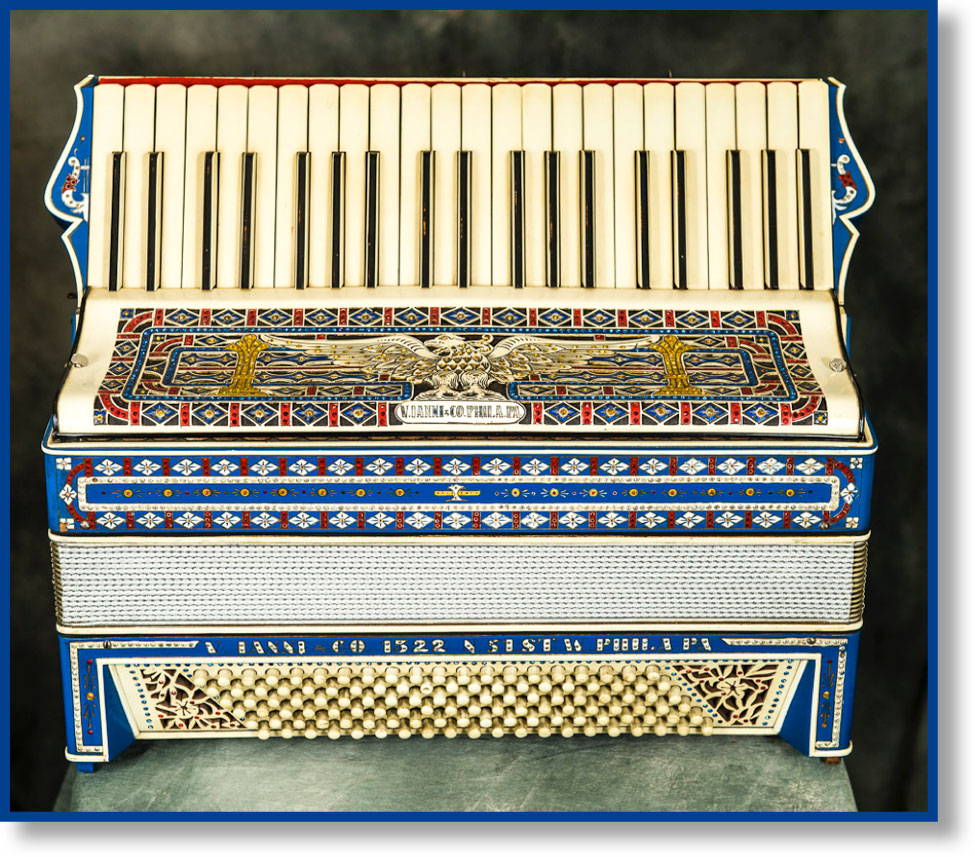
I have recently released my new book “Accordion Stories from the Heart.” It’s a collection of accordions from around the world and their stories, inspired by the extraordinary people who played them. There are more than 40 tender memory-evoking stories of people who played or listened to accordions over the course of their lives. It also features over 70 full color photos of spectacular, beautifully hand-built accordions. I am happy to report that people have not only been anxious to see the book but to also schedule an event where I will discuss the book, display sample vintage accordions and play a selection of popular songs to complete the event.
Paul Ramunni, author
Sept 2018
-
An Interview with Paul Ramunni
Jerry Homolka produced this video interview and captured the essence of our mission here at The New England Accordion Connection and Museum Co. Thank you Jerry & Enjoy Everyone!! An Interview with Paul Ramunni
-
Kirkus – Profiles
Read reviewer/author Charles Cassady’s interview with Paul from Kirkus Reviews: Lavishly Illustrated Essays on Accordion Culture Find Grace Notes I’ve told that story about a hundred times. It still gives me goosebumps,” Angelo Paul Ramunni says, referring to the serendipity that led him to create an accordion-based museum in his home in Canaan, Connecticut—and, by…
-
Author Talk & Mini-Concerts Schedule
Hi Everyone, I have recently released my new book “Accordion Stories from the Heart.” It’s a collection of accordions from around the world and their stories, inspired by the extraordinary people who played them. There are more than 40 tender memory-evoking stories of people who played or listened to accordions over the course of their…
-
The Surprising and Spectacular Joy of Accordions
GIZMODO | Show Me Your Nerd The Surprising and Spectacular Joy of Accordions Click here to see on gizmodo.com
-
Hartford Courant Visits New England Accordion Museum!
[one_third last=”no” class=”” id=””] Our accordion collection includes hundreds of unique and beautifully handcrafted pieces, however, our visitors would agree that it’s the narrated experience that becomes most memorable after visiting NEAM. Director, Paul Ramunni, curates the exhibits and shares memories that tell a genuine story about each accordion. The New England Accordion Museum would…
-
News From NEAM: July 2015 Edition
Accordions And Their Stories: A Living Legacy [one_half last=”no” class=”” id=””]The New England Accordion Museum opened its doors in the Fall of 2011 in Canaan, Connecticut. How it came to be is, in itself, an interesting story. I learned to play the accordion from age 10 to 17 while growing up on Long Island. I…
-
Accordions Alive Event Was A Success!
[one_half last=”no” class=”” id=””]A Legendary Experience: Event Overview New and used accordions were displayed for sale along with sheet music of Italian and American accordion classics.. Entertainment was provided by Tony Lovello, a legendary accordionist that kept the crowd roaring with laughter and happy to see Tony perform with the same passion he always puts…